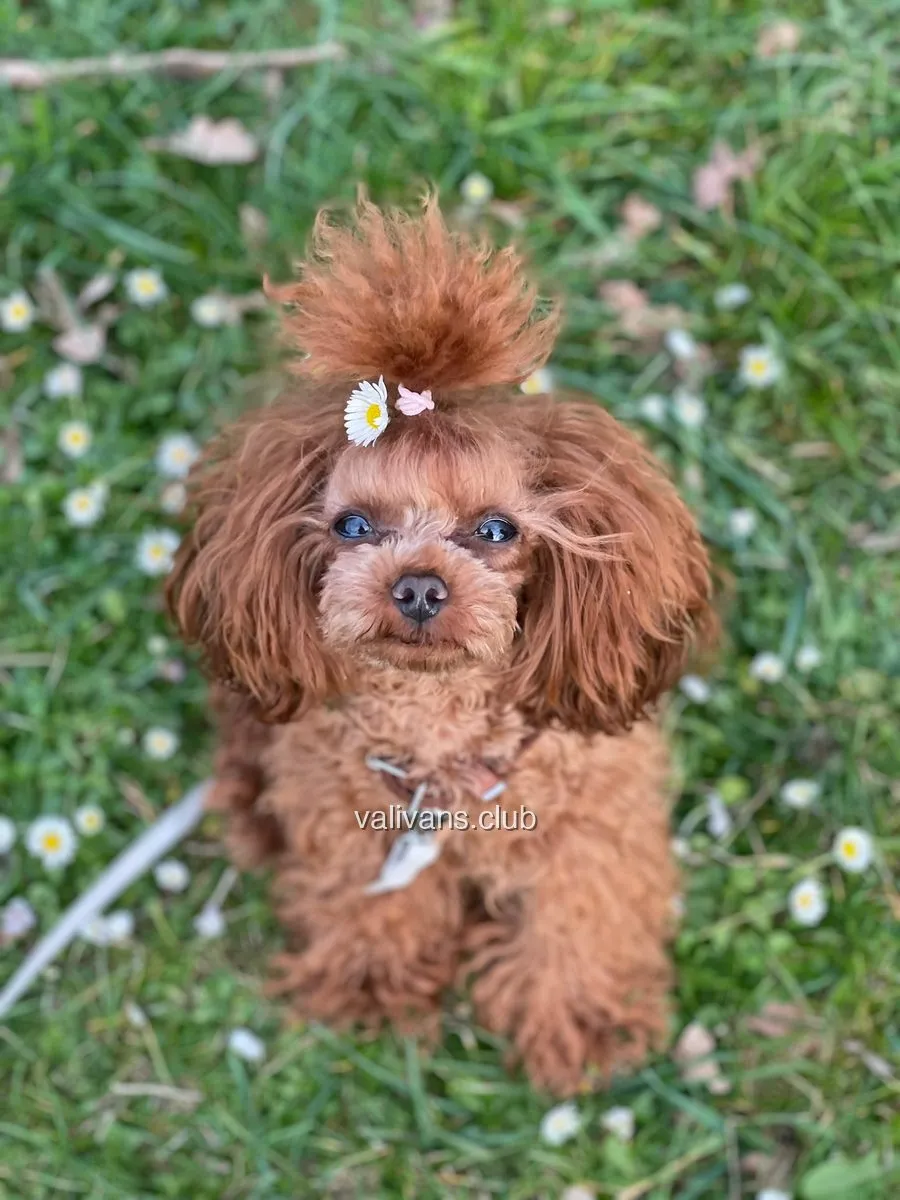
“Teacup poodle” is a sales label, not a poodle variety. Sellers use it for very small dogs, usually advertised at 1.5–2.5 kg (3–5 lbs) and under 23 cm (9 inches). The FCI standard for the Poodle (No. 172) recognizes four sizes, and the smallest is the Toy Poodle: over 24 cm up to 28 cm at the withers, with 25 cm as the ideal. This guide explains what the teacup label means, why a dog sold under it is a Toy Poodle on paper, and what to ask a breeder instead.
We are a Ukrainian family kennel registered with the UKU (an FCI member), and our family lives in Valencia, Spain. We breed Toy Poodles within the FCI standard and do not sell dogs as “teacup”.
What Is a Teacup Poodle?
A dog sold as a teacup poodle is, by registration, a Toy Poodle. “Teacup” is not a variety or a size class for the FCI or the AKC. Sellers use the word for dogs at or below the bottom of the Toy range, usually meaning under 2.5 kg (5 lbs) and under 23 cm (9 inches) at the shoulder.
That matters when you buy. The FCI Toy standard runs from over 24 cm up to 28 cm, allows 1 cm below 24 cm, and lists a Toy under 23 cm as a disqualifying fault. A dog advertised as smaller than that falls outside the standard its own pedigree names. A responsible breeder selects healthy parents within the standard; it does not chase the smallest possible dog, breed from runts or underfeed puppies.
Key Fact
“Teacup” is a sales word, not a breed or an FCI size. The smallest poodle the FCI (Fédération Cynologique Internationale) recognizes is the Toy Poodle: over 24 cm up to 28 cm at the withers, ideal 25 cm. A dog advertised as a “teacup poodle” is a Toy Poodle marketed by size.
How Does “Teacup” Compare with the FCI Poodle Sizes?
The FCI standard sorts poodles by height at the withers. “Teacup” is not an FCI size:
| Variety | Height | Weight | FCI Recognized |
|---|---|---|---|
| “Teacup” (sales label) | Usually advertised under 23 cm (9 in) | Usually advertised at 1.5–2.5 kg (3–5 lbs) | No — not an FCI size; a Toy under 23 cm is disqualified |
| Toy Poodle | Over 24 cm up to 28 cm (9.5–11 in), ideal 25 cm | 2.5–4 kg (5–9 lbs) | Yes — the smallest variety |
| Miniature Poodle | 28–35 cm (11–14 in) | 5–7 kg (11–15 lbs) | Yes |
| Medium Poodle | 35–45 cm (14–18 in) | ~8–15 kg (18–33 lbs) | Yes |
| Standard Poodle | 45–60 cm (18–24 in) | 20–32 kg (45–70 lbs) | Yes |
The standard sets heights only. The weights are typical ranges, not part of the FCI standard. For the whole size ladder, see our smallest poodle guide.
Toy Poodle Temperament & Personality
A small dog sold as a teacup is a Toy Poodle, so it has the Toy Poodle's temperament: a big personality for its size. Poodles consistently rank among the most intelligent dog breeds in the world (#2 overall in canine intelligence, just behind Border Collies).
What you can expect from a well-bred Toy Poodle:
- Highly intelligent — they learn commands quickly and love mental stimulation
- Affectionate and loyal — they bond deeply with their owners and love being close
- Alert but not yappy — when properly socialized, they're confident and calm
- Great with families — gentle with children and friendly with other pets
- Adaptable — equally happy in an apartment or a house with a garden
- Travel-friendly — their small size makes them easy companions for flights and road trips
Early socialization is key. At Valivans, our puppies are raised in a family environment with three children, other dogs, and everyday household sounds. This produces confident, well-adjusted dogs that adapt quickly to their new homes.
Toy Poodle Colors
Toy Poodles come in a wide range of solid colors. The most popular and sought-after include:
- Red — the most demanded color, ranging from deep mahogany to bright copper — see our red Toy Poodle guide.
- Apricot — a warm, golden tone that's lighter than red. Elegant and eye-catching.
- Black — classic and striking, with a glossy, jet-black coat.
- White — pure and bright, requiring more grooming maintenance but absolutely stunning.
- Cream — soft and warm, a lighter variation of apricot.
- Brown/Chocolate — rich and deep, less common than other colors.
At Valivans, we specialize in red and apricot Toy Poodles within the FCI standard — the two most sought-after colors. Our breeding dogs carry strong color genetics, producing puppies with rich, vibrant coats that maintain their color into adulthood.
Are Teacup Poodles Hypoallergenic?
Yes. This is one of the biggest advantages of Toy Poodles, whatever label a seller puts on them. They have a single-layer, curly coat that sheds minimally and produces less dander than most breeds. This makes them one of the best choices for people with allergies.
No dog is 100% hypoallergenic, but poodles come as close as possible. Many allergy sufferers who cannot live with other breeds find they have no issues with poodles. Combined with their small size (less surface area = less dander), Toy Poodles are often recommended by allergists as a suitable pet option.
Why Is Breeding for “Teacup” Size a Health Risk?
A well-bred Toy Poodle from health-tested parents can live 12–16 years, and many reach the upper end of that range. Breeding for the smallest possible size works against that: the further a dog sits below the standard, the higher the risk of hypoglycemia, fragile bones and dental crowding. Our Toy Poodle health guide covers these risks in detail.
Common Health Considerations
- Patellar luxation — a knee condition common in small breeds.
- Progressive Retinal Atrophy (PRA) — an inherited eye condition that leads to gradual blindness.
- Hypoglycemia — low blood sugar, especially in very young puppies and very small dogs. Managed with proper feeding schedules.
- Dental issues — small mouths can crowd teeth. Regular dental care is important.
Why Breeder Choice Matters
The single biggest factor in your Toy Poodle's health is where you buy it. Reputable breeders health-test both parents and provide documentation. Pet shops and puppy mills skip health testing, leading to heartbreak and expensive vet bills.
How to Keep a Small Toy Poodle Healthy
- Regular vet checkups — every 6 months for small breeds
- Proper nutrition — high-quality, small-breed formula fed 3–4 times daily
- Dental care — brush teeth regularly, provide dental chews
- Temperature awareness — tiny dogs lose body heat faster; provide warmth in winter
- Gentle exercise — short walks and indoor play; avoid jumping from heights
Toy Poodle Grooming
Poodle coats don't shed, but they do grow continuously — similar to human hair. This means regular grooming is essential:
- Brushing: Every 2–3 days to prevent matting
- Professional grooming: Every 4–6 weeks for a trim
- Bathing: Every 2–3 weeks with a gentle, dog-specific shampoo
- Ear cleaning: Weekly — poodles are prone to ear infections
- Nail trimming: Every 2–3 weeks
Many owners choose a "puppy cut" (short, even length all over) for easy maintenance. It keeps a Toy Poodle looking neat while minimizing grooming time between professional visits.
How Much Does a Teacup Poodle Cost?
Dogs sold as teacups are often priced at the top of the market, but you pay for the label, not for a rarer variety: the pedigree will still say Toy Poodle. What actually moves the price of a Toy Poodle:
| Factor | Impact on Price |
|---|---|
| Pedigree quality | Champion parents = higher price |
| Color | Red and apricot command premium prices |
| Size | Sellers charge more for the smallest dogs; a size below the FCI standard is a fault, not a premium |
| Health testing | Full parent testing adds to breeder costs |
| Location | Prices vary by country and region |
In Europe, expect to pay €2,500–€5,000 for a Toy Poodle from a reputable breeder with FCI pedigree and health documentation. If you see prices significantly below this range, question the breeder's practices. If a seller charges extra for a dog sold as a “teacup”, ask for the parents' heights and the pedigree.
What should be included in the price from a reputable breeder:
- FCI/UKU pedigree documentation
- Veterinary passport
- Microchip
- Age-appropriate vaccinations
- Health certificate from a licensed vet
- Post-adoption support and guidance
How to Choose a Reputable Toy Poodle Breeder
The breeder you choose determines your puppy's health, temperament, and quality of life. Here's what to look for:
Green Flags
- Registered with FCI, AKC, or national kennel club — proves adherence to breed standards
- Health tests both parents and shows you the documents
- Provides pedigree documentation — traceable ancestry on both sides
- Raises puppies in a home environment — not in kennels or cages
- Welcomes visits — lets you meet the parents and see living conditions
- Asks YOU questions — a good breeder cares where their puppies go
- Offers post-adoption support — available for questions after you take puppy home
Red Flags
- No pedigree or health documentation
- Puppies sold as “teacup” or “micro”, or with a promised adult size below the Toy standard
- Won't let you visit or meet the parents
- Multiple breeds available at once (puppy mill indicator)
- Puppies available immediately with no waiting list
- Prices that seem too good to be true
- Pressure to buy quickly
Buying a Small Toy Poodle in Spain & Europe
Choose a Toy Poodle within the FCI standard instead, and check:
- FCI registration — the FCI is the international standard in Europe. Ensure the breeder's kennel is registered.
- EU Pet Passport — required for travel between EU countries. Your breeder should provide this.
- International delivery — many European breeders offer safe delivery via pet-friendly airlines or ground transport.
- Language — look for breeders who communicate in your language for easier coordination.
Looking for a Small Toy Poodle?
Valivans, a Ukrainian family kennel, breeds red and apricot Toy Poodles within the FCI standard in Valencia, Spain. UKU-registered (FCI-recognised), from health-tested parents, raised at home. We deliver across Europe and internationally.
Frequently Asked Questions
“Teacup” is not an FCI size, so there is no standard answer. Dogs sold as teacups are usually advertised at 1.5–2.5 kg (3–5 lbs) and under 23 cm (9 inches). The smallest poodle the FCI recognizes is the Toy: over 24 cm up to 28 cm at the withers, with 25 cm as the ideal. Toy Poodles reach most of their adult height by about 7–10 months and are generally fully grown by 12 months.
Dogs sold as teacups are often priced at the top of the market, but no pedigree records the label: by registration they are Toy Poodles. In Europe, a Toy Poodle from a reputable breeder typically costs €2,500–€5,000, depending on pedigree, color and health testing. Red and apricot Toys tend to cost the most.
A healthy Toy Poodle lives 12–16 years with good care and health-tested parents. Dogs bred for extreme smallness carry more risk of hypoglycemia, fragile bones and dental problems, so a Toy within the FCI standard is the safer choice for a long life.
A Toy Poodle is gentle and affectionate and does well with children who are taught to handle it carefully. The smaller the dog, the more easily a fall or a rough grab hurts it, so young children need supervision. Our puppies are raised at home with three children.
We do not sell dogs as “teacup”, because it is not a size the FCI recognizes. Valivans is a Ukrainian family kennel registered with the UKU (an FCI member) that breeds Toy Poodles within the FCI standard; the family lives in Valencia, Spain. Every puppy comes with a UKU pedigree (FCI-recognized), a health certificate, a microchip and vaccinations. Contact us at valivans.dogs@gmail.com or on Instagram @valivans.club.
A well-socialized Toy Poodle is not an excessive barker. It is alert and may bark when someone comes to the door, but early training and socialization make it a calm, well-mannered dog. A smaller size does not change that.